Wendy & Leslie Rebanks Fellowship


Categories
About
Established in 2007, the Wendy and Leslie Rebanks Fellowship advances postdoctoral research in Art & Culture and Natural History, fostering innovative scholarship and expanding the understanding, interpretation, and diversity of ROM’s collections. Since its inception, the fellowship has supported 12 projects that reflect the breadth of ROM’s research strengths, including investigations of Huron-Wendat effigy smoking pipes, the authentication of Greek and Roman antiquities, genomic studies of Blue Whales, and conservation initiatives aimed at protecting the endangered Red Knot shorebird. These projects demonstrate the fellowship’s vital role in advancing new knowledge, fostering interdisciplinary collaboration, and deepening public engagement with both art & culture and the natural world.
Call for proposals is currently closed and we are not accepting applications at this time.
Please check back for future updates.


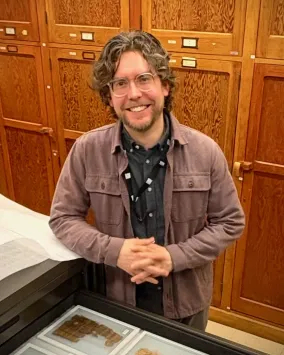
Dr. Gregory Fewster, 2025 Rebanks Postdoctoral Fellow – Art & Culture
When the ROM opened its doors in March of 1914, one of the most publicized galleries housed the “Walter Massey Biblical Collection.” But over the last hundred years or so, most of these objects were moved to collections storage and the original intentions for the collection have been forgotten. It is increasingly important in today’s museological climate to remember the history of collections; to understand how and why objects were dislocated from their original communities to far-away galleries and storerooms, and to confront the fragmented record of that movement. Drawing on extensive archival research, this project is telling new stories about the formation of the ROM itself and the important place occupied by the Walter Massey Collection. It documents how Charles Currelly partnered with Toronto philanthropists, the Masseys, to bring everyday objects excavated from Egypt and Palestine to Toronto in order to illustrate the world of the Bible for the Canadian public. By recovering the forgotten evidence for the assembly of the Massey Collection, this project is contributing to ROM’s efforts to increase transparency of the history of its collections.
Project Images


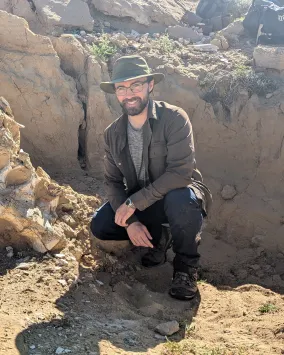
Dr. Thomas Dudgeon, 2025 Rebanks Postdoctoral Fellow – Natural History
Gars are an ancient group of ray-finned fishes that can be found today within the rivers of eastern North America, with some species extending as far north as southern Ontario. These animals are specialized carnivores adapted for catching and eating other fish, and are unusual in having undergone little change over the last 100 million years. Despite their deep history and conservative morphology, we know relatively little about their evolution due to the scarcity of complete fossil. At ROM, I am describing an exceptionally well-preserved gar fossil from the Late Cretaceous of North Dakota that represents the best-preserved Mesozoic gar found to date, and will help address significant gaps in our understanding of the evolution of these animals. Using CT scanning, 3D modelling, and computational analyses, I will investigate how this fossil gar differs from living species and other known fossils. The occurrence of this specimen during the Cretaceous offers a rare chance to understand how this lineage may have changed across the end-Cretaceous mass extinction, providing new data on ecological resilience that can benefit modern gar conservation efforts.
Wendy & Leslie Rebanks Fellows