The Stream that Shapes a City



- Published
- Category
-
Science
1
According to the ancient Korean practice of geomancy (think 風水, feng shui for urban planning), the Cheonggyecheon stream demarcates a perfect location for a city of significance. Running from the Inwangsan mountain down to the mighty Hangang river, the stream’s winding course inscribes on the landscape a shape resembling the taegeuk, which appears in the center of the South Korean flag and is similar to a yin-yang symbol. In 1394, the city of Hanyang was established there and designated as the capital of the Joseon Dynasty. Today, we know that city as Seoul, the capital of South Korea.
Cheonggyecheon was pivotal in the establishment of the city, and its relationship to the community followed an equally meandering course over the following centuries. By the 1440s, a lively debate had arisen regarding whether the stream should formally remain as a hallowed place of geomancy or shift to a more functional role of waste expulsion, responding to the needs of a growing urban population. The latter side won.
Fast-forward a few centuries later to the 1950s and the condition of the stream’s water and surrounding low-income dwellings was considered so shameful that the city moved forward with plans to bury the stream under concrete, creating an elevated highway along the site: the Cheonggye Elevated Motorway. In doing so, communities living along the stream were demolished, displacing large populations to the hills on the edge of town. By the project’s completion in 1977, there were proclamations that Seoul had finally established itself as a modern city of the world.
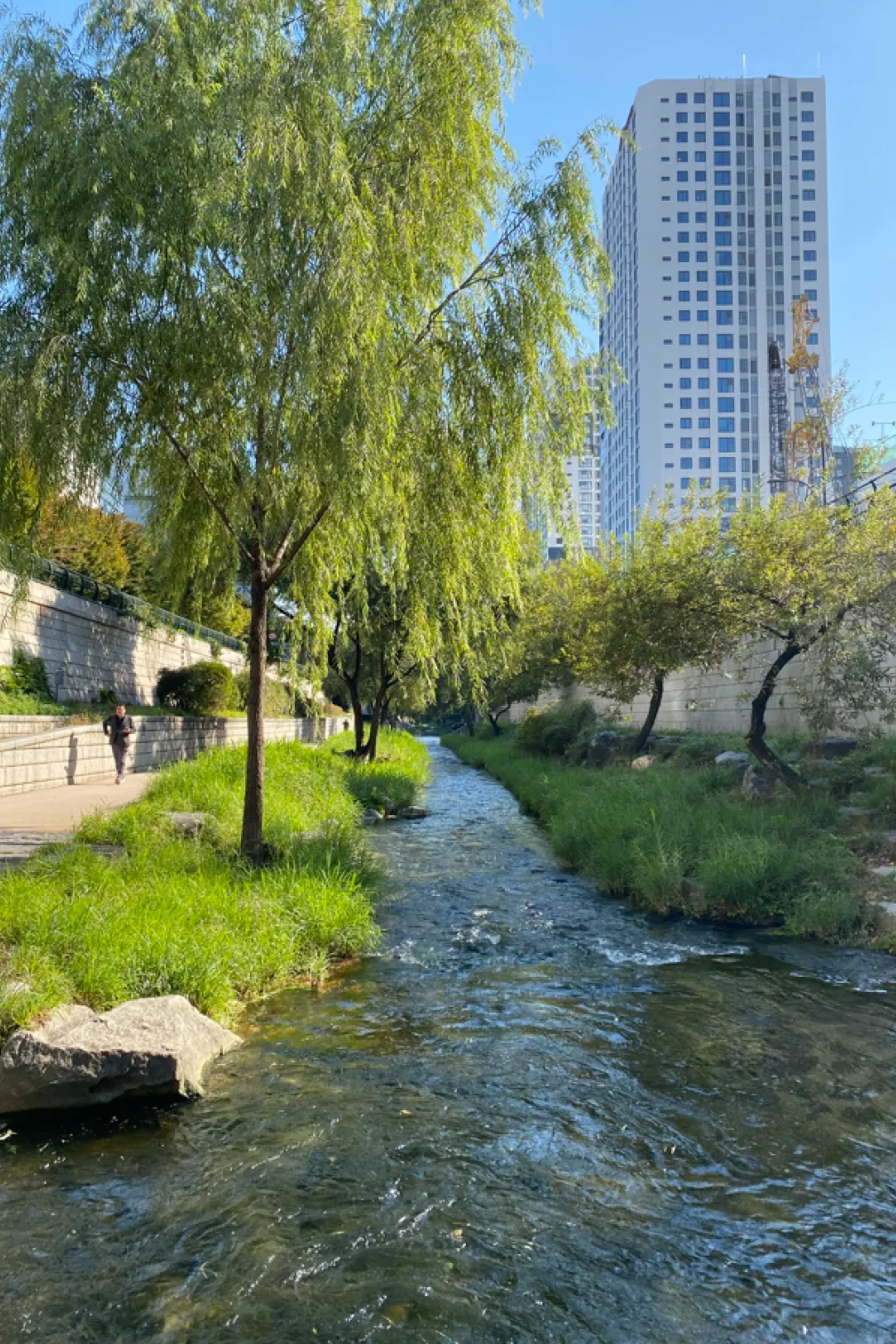
For many cities, urban progress might feel like it ends there, with the establishment of automotive infrastructure. Interestingly, that’s not the case for Seoul. By 2002, the cost of maintaining that elevated highway through the heart of Seoul had become so expensive that its fate took centre stage on a political ballot. Lee Myung-Bak, Seoul’s newly elected mayor, moved forward with plans to demolish the highway and restore the stream that ran through the area years ago. Shops and communities thriving along the crumbling highway were evicted or relocated, and excavators carved a 6 km long sunken path through the heart of the city, to which they pumped as much as 120,000 tons of clear water daily, primarily from the Hangang river. In 2005, with much fanfare, the Cheonggyecheon stream was proclaimed reborn.


1
In the 20 years since the stream’s reopening, Cheonggyecheon has been the subject of several documentaries, news articles, and YouTube videos, mostly focusing on it as a site to celebrate urban sustainability. There are certainly reasons to rejoice: The stream channel now acts as a crucial flood relief channel for the city. The waters of Cheonggyecheon also cool the area by roughly 3 to 6°C, offering residents refuge from the urban heat island effect which is exacerbated by climate change.
Pairing the highway’s demolition with investments in public transit, traffic congestion slightly improved in downtown Seoul, paradoxically improving the convenience for drivers in the urban core. Local air quality also improved, with nitrogen dioxide levels falling by 35 percent and notable declines in local respiratory disease rates.
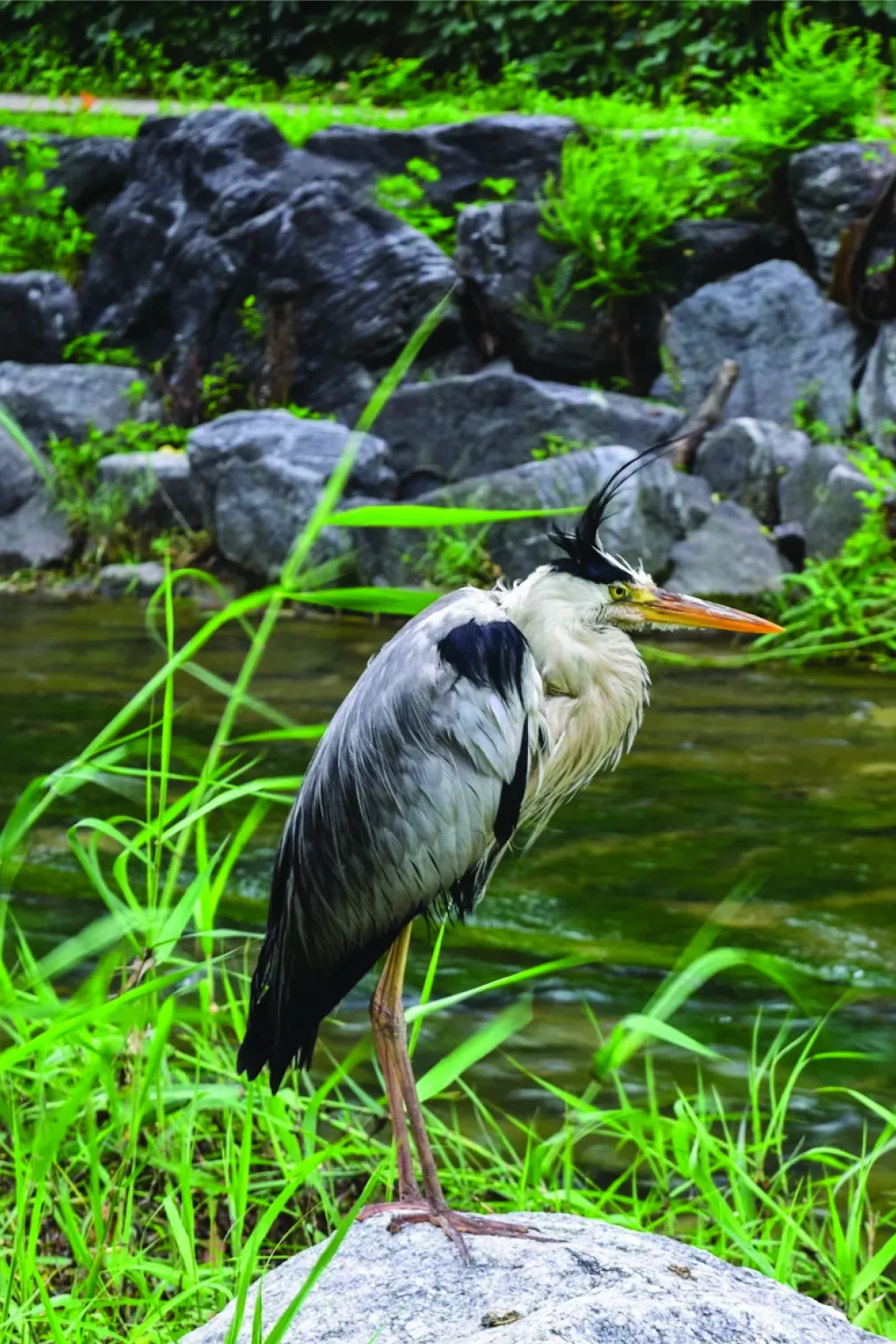
Additionally, biodiversity in the urban core skyrocketed; parts of the stream are now formally designated as a migratory bird habitat, in which a 2024 survey by the Korea Ornithological Institute identified 38 bird species. Likewise, fish surveys have shown increases from four fish species inhabiting the stream before restoration to 33 fish species by 2025. Altogether, a 2022 survey by the Seoul Institute identified 492 plant species and 174 animal species along the stream.
And finally, one might argue that the stream serves the culture and spirit of the downtown community it runs through—it receives an average of 47,000 visitors each day (totaling 330 million people since its reopening in 2005), the vast majority of whom are locals who might be cooling off along its banks in the daytime, or strolling along it with friends by night.
On a recent visit to Seoul, I was curious to learn more about Cheonggyecheon and speak with locals to see how their understanding of the stream aligned with the way that it has been perceived globally. Is Cheonggyecheon, as an early and potentially influential example of urban environmental sustainability, a guiding light that all cities should try to emulate? Or are there deeper, more nuanced lessons we can learn from it?
Is it accurate to say that Cheonggyecheon was restored, or is the stream that runs through the heart of Seoul today—with a different source of water and a more constrained length, course, and width than the original—just a superficial facsimile of the earlier stream that flowed there naturally? Ultimately, do projects like this really make a difference when it comes to addressing our complex global crises, or are they a distraction, accelerating gentrification and benefitting only affluent city-dwellers, while leaving the rest to suffer? In other words, is Cheonggyecheon really the solution, or is it just another part of the problem?
I spoke with Dr. Buhm Soon Park, Director of the Center for Anthropocene Studies at KAIST (Korea Advanced Institute of Science and Technology), and Dr. Jihye Kim, a post-doctoral fellow at KAIST who specializes in environmental sociology. They both expressed deeply conflicted feelings about Cheonggyecheon. According to Dr. Kim, “The problem is not Cheonggyecheon, but the way it was made. The government pushed a plan forward with bad communications—there were a lot of small shops, and unless they were relocated to a designated space, we do not know where they went.” Dr. Park noted, “It’s not a restoration—it’s a new product. It represents a sacrifice of one part of society for the benefits of others.”
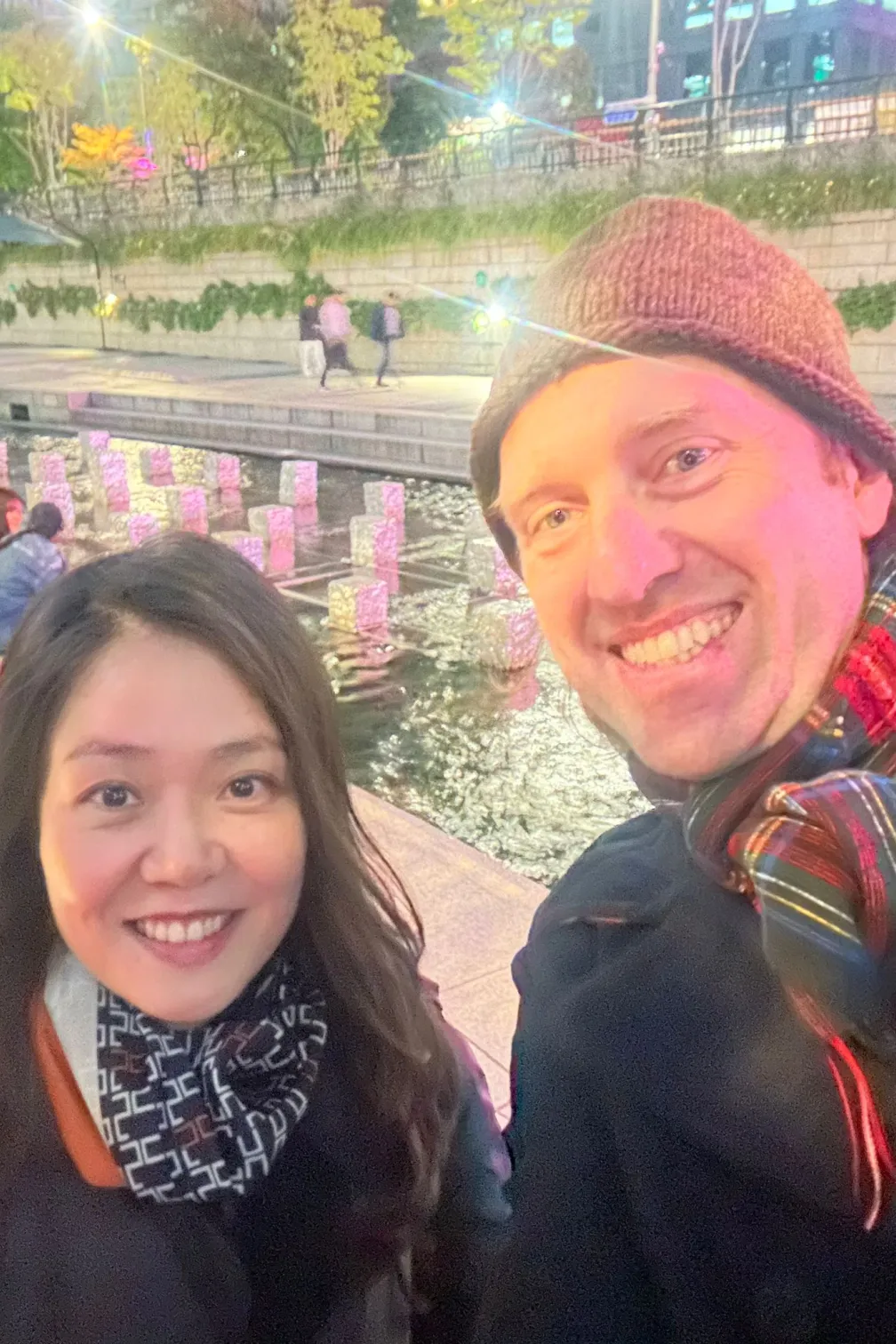
I also had the opportunity to visit Cheonggyecheon with Dr. Vicki Kwon, Curator of Korean Art and Culture at ROM, who grew up in Seoul. As we took selfies and strolled past crowds of tourists and locals watching a laser light show projected over the stream, Dr. Kwon agreed that the process of creating Cheonggyecheon was deeply checkered, and the project remains a subject of ongoing criticism.
Even the Cheonggyecheon Museum, which tells the story of the city and the stream from the 1300s to today, expresses a tone of mild disappointment with the final outcome of the project, noting that the pumping of source water is costlier than anticipated (annual maintenance currently costs roughly 2.9 billion won—nearly 3 million dollars). As noted in one museum label, “restoration work on historical and cultural heritage sites near the stream failed to meet people’s expectations … the restoration of Cheonggyecheon is not fully complete, leaving the stream with an open future and plenty of room for citizens to make changes.”
Given these critiques, can we really look to Cheonggyecheon for optimism regarding the future of the planet? Dr. Park notes, “There is a certain maintenance cost for the optimism—including a social cost, and an economic cost—at the sacrifice of others. In some sense it’s like air conditioning in a big building—you have to run it, you have to repair it, you have to pay the electricity, and so on.”
It is clear that the Cheonggyecheon of today is not the same stream that flowed here centuries earlier. The naturally intermittent stream would disappear during dry months, but now runs perennially.



1
Cheonggyecheon’s water chemistry is also not what it was. The water chemistry of a stream is like a fingerprint formed by the specific geology and biology of a watershed. This signature can be ecologically significant, as with salmon using it to locate their natal streams when spawning. But even if Cheonggyecheon’s flow and chemical signature are not what they were before, it doesn’t mean it can’t be a site of ecological significance today.
The rapid rise in fish biodiversity and locally rich populations of insects and birds along the stream speak to an ecological need that is being met, regardless of the water’s source.
There’s a common misconception that “important” biodiversity (such as the presence of endangered species) only occurs in “pristine” areas such as natural parks, far from urban centres. However, conservation biologists are increasingly challenging this assumption, pointing to the harm it can cause by overlooking endangered populations within cities.
A study I co-authored in 2018 found that in the USA, endangered species would generally be better off if protected areas were randomly distributed across the country, instead of being located where they are. This might sound surprising, but it makes sense. National parks are congregated in remote, often mountainous areas, whereas biodiversity hotspots are often clustered in lowland habitats. Think of the river deltas at the crossroads of ecosystems, which happen to be the same kinds of places that humans like to build cities. So, even a small amount of habitat stewardship in cities can potentially go a long way for preserving important biodiversity.
Cheonggyecheon’s history as a stream over the past millennium is intertwined with the history of Seoul. It has challenged the people living there (seasonal flooding in the early days of settlement) and it has been challenged, in turn, by them, ultimately to the point of burial. But, rising again like a phoenix, the stream today that we call Cheonggyecheon is an interwoven expression of humans and nature—what Dr. Park and others refer to as “natureculture.” It is served by the community, in the enormous efforts invested in keeping it flowing and clean of trash. In turn, it serves the community, providing benefits encompassing physical and mental health.
Fittingly, the start of the stream today, close to Seoul’s City Hall, is marked by a towering sculpture called Spring by the artists Coosje Van Bruggen and Claes Oldenburg. The stream’s water flows from the sculpture, whose spiral form alludes to both a snail shell and the pagoda of traditional Korean architecture, with intertwining blue and red ribbon designs echoing a traditional Korean woman’s dress. A sign speaks directly to Cheonggyecheon’s unifying of the “opposites in nature and the human spirit.”
We can learn valuable lessons from Cheonggyecheon, even if they’re not the obvious ones that first come to mind. It is shortsighted to think that all we need to do to solve our global problems is build a bunch of rivers in our cities.
Overhauling our environments can have major consequences—positive and negative—to our communities and ecosystems. However, it’s also important to remember that Cheonggyecheon was renaturalized not solely for aesthetic or environmental reasons, but also because of the heavy economic, social, and environmental costs associated with maintaining an elevated highway. Given that, it is possible that aging car-centric infrastructure will increasingly be giving away to more eco-friendly designs and structures in cities globally, simply out of economic considerations.
Although the stream’s 2.9 billion won annual maintenance may sound steep, it is a drop in the bucket (0.006%, to be precise) compared to Seoul’s municipal budget of 45.7 trillion won in 2024. The net benefits have evidently been clear enough that Seoul has since removed 16 more elevated highways.
Closer to home, the City of Toronto’s website states that such economic considerations were central in the Toronto City Council’s 1999 vote to take down the Gardiner Expressway East, and are doubtless important for numerous other cities globally that are currently weighing the economic, social, and environmental drawbacks of car-centric infrastructure. The important question ahead of us might not be “should we create more streams,” but rather “what is the appropriate path forward for retiring our “modern” 20th-century concrete urban forms, whenever that day may come?” In this case, it is inspiring to consider that it can start with the root of our connections with local landscapes—as much as possible, not pitting societal choices against environmental ones, but embracing models that align the two, to mutual benefit.
A single project like Cheonggyecheon might not feel like it changes the planet, but it certainly changes the community and its resident ecosystems. From protecting migratory birds to potentially shifting the attitudes of citizens and politicians towards environmental stewardship, Cheonggyecheon provides ecosystem services far beyond Seoul’s city limits.
One thing that has struck me as a fascinating change happening around the world today, is that many of our cities’ arguably “worst” places (whether considering traffic congestion, pollution, or other impacts) are rapidly transforming into their best. This kind of story is unfolding in Toronto’s own Port Lands (in the newly established Biidaasige Park, and ongoing work nearby), and has parallels around the world.
In Seoul, Dr. Park and Dr. Kim took me to World Cup Park, located on land that had been an island called Nanjido (“Orchid Island”) in the Hangang river. That island was joined to the mainland in 1977 as Seoul’s municipal landfill site, which it remained until 1993. Today, rather than being a site of filth and stench, it is a renaturalized area, with an artificial mountain (Haneul Park) overlooking the city and Hangang river.
Watching the sunset from the top of the mountain, we listened to a chorus of women playing panpipes, standing in a spectacular field of swaying Miscanthus tallgrasses. A modern sculpture resembling a globe made of mirrors, The Rock of Wishing, sparkled rainbow-like in the last glow of the day. As lovers embraced and birds sang songs unfamiliar to me, Dr. Park related stories of bombings that had occurred in the 1950s during the Korean War at various sites below us. “Modernity” of course means different things to different people, but the global changes associated with the mid 20th century ramping up of global economic activities and infrastructural projects, sometimes referred to as the “Great Acceleration,” still defines that concept for many of us. However, the setting on the mountain at sunset was almost ecstatically beautiful, and it occurred to me that letting go of the “modern” ideals— and trappings—of the mid-20th century had never felt so good.
It is tempting to leave things off in that happy moment, but I found myself caught by something else that Dr. Kim said on the top of the landfill: “It’s very beautiful up here, but it’s also very shallow. People keep forgetting what they’ve done.”
Which brings me back to my original question: are sites like Cheonggyecheon and World Cup Park a fundamental environmental improvement, or are they a shallow cover-up? We should, of course, be cognizant about how superficial these types of projects might be, but also not be afraid to carry out actions that offer net benefits to humans and ecosystems, even if they diverge from pure restoration or a strict notion of what’s “natural” at a given site.


1
To me, it doesn’t really matter that Cheonggyecheon is not natural—there may have been adaptive benefits to some local species in having the stream be intermittent and sourced with its original waters, but other species will benefit from its continuous flow and the high water quality that is currently maintained.
Given my own only superficial knowledge of the site’s history, it is impossible for me to say whether the ends justified the means, considering the societal sacrifices involved with constructing Cheonggyecheon. However, with twenty years of hindsight, the emergent picture seems in this case to be one where the stream provides countless more benefits to humans and nature than had the elevated highway stayed in place.
In a follow-up conversation, Dr. Kim elaborated: “Neither nature nor culture exists only in the present. They are movements flowing from the past toward the future, and never complete. So, when we think about landscape planning, especially for ‘urban nature,’ perhaps it’s more important to ask what we should remember, what we should let be forgotten, and what kinds of futures we want or don’t want to make.” It’s important that the displaced communities around Cheonggyecheon are remembered, particularly to guide future progress along a path that’s socially just. I am happy, however, to leave behind the ideology that defines urban modernity as having a highway run through the heart of a community. In the end, we are left with a powerful lesson for societies worldwide. Organizing ourselves in a way that internalizes and formalizes ecosystem management is not new, and is not something to be afraid of. Rather, perhaps, it is what makes us human.
Soren Brothers is the Allan and Helaine Shiff Curator of Climate Change at ROM.
Soren Brothers is the Allan and Helaine Shiff Curator of Climate Change at ROM.
