Reading Nature's Record


- Published
- Category
-
Natural History
- Author
-
..
Down below the cool, deep waters of Crawford Lake, thousands of years of history are preserved in mud. For decades, scientists have studied the visible and microscopic evidence of the Earth’s changes that are recorded in layers of sediment at the bottom of the lake. This fall, visitors are invited to see the evidence themselves and to learn the stories Crawford Lake has to tell.
“The rich and varied history of Crawford Lake reveals the deep, ongoing connection be-tween humans and nature,” says Soren Brothers, the Museum’s Allan and Helaine Shiff Curator of Climate Change.
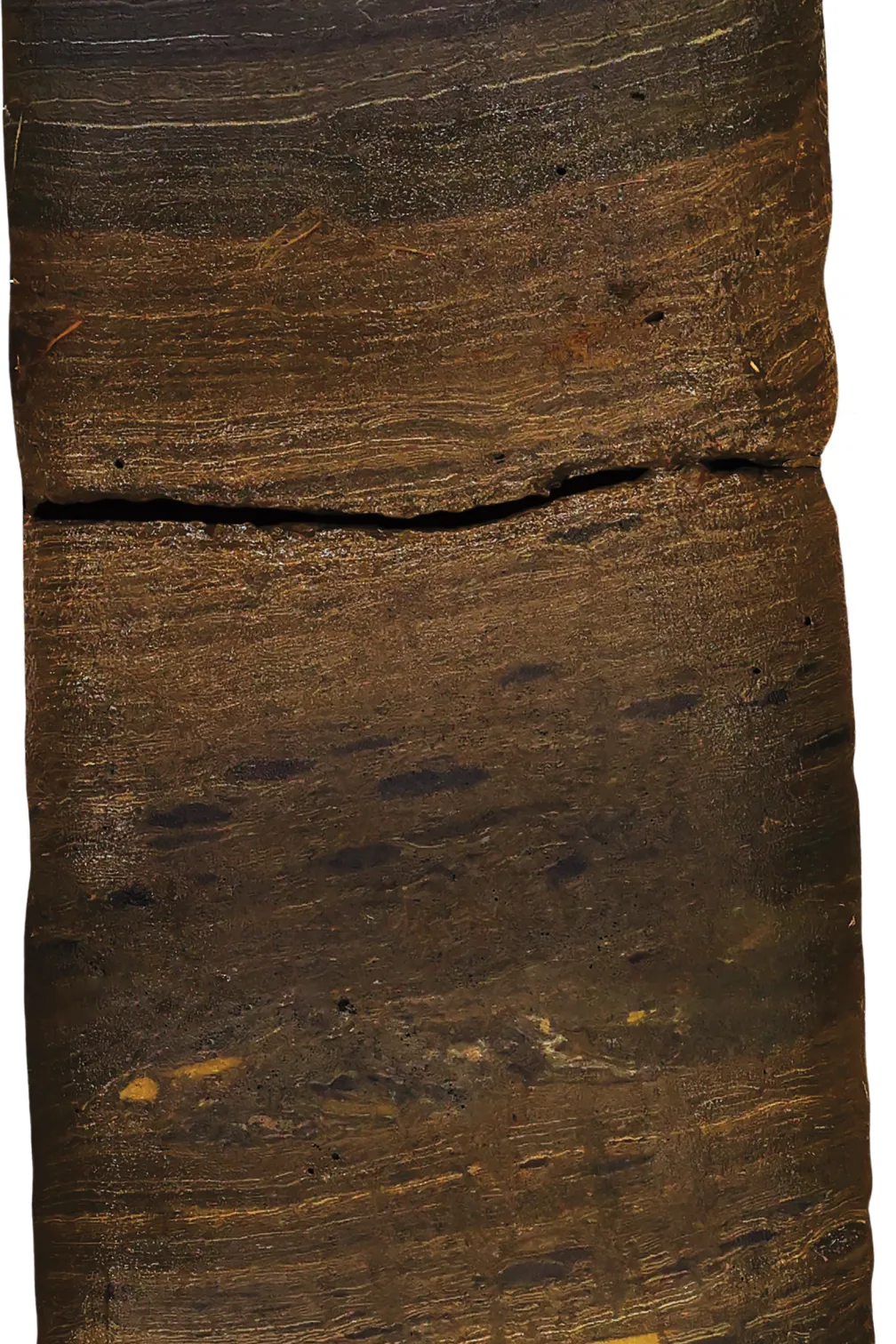
Nature is an excellent record keeper. Sedimentary rock forms on the Earth’s surface, shaped layer by layer with soil, precipitation, and erosion. As a tree grows, it forms annual rings that can be counted backward in time to mark its first year of growth. The Crawford Lake sediments hold history in a similar way, in the layers of sediment that are deposited at the bottom of the lake every year. Learning to read this record illuminates how human action has influenced the Earth—both here in Ontario and around the world.
Crawford Lake’s shape, size, and position in the ancient lime-stone of the Niagara Escarpment influence how sediments are preserved below the still water at the bottom of the lake. The lake is meromictic, which means the upper, shallow waters never mix with the lower waters. At the deepest part of the lake, 24 metres below the surface, this lack of mixing causes sediments to form in annual layers called “varves.”
To collect a sample of the lake floor, scientists fill a hollow coring rod with dry ice, alcohol, and lead weights. The device, called a “freeze corer,” is then plunged through the bottom of the lake to pierce the sediments. While buried in the lake floor, sediments freeze onto it. When it is drawn back up to the surface, the layers of mud preserved in a crust come with it. This sample is called a “core,” and it is what researchers study back in their labs
“Many disciplines and perspectives—geology, botany, palaeoecology, archaeology, molecular biology, geochemistry, Indigenous Knowledge, and more—have come together to reveal the natural and human history of Crawford Lake,” says DeborahA. Metsger, Assistant Curator of Botany in the Museum’s Department of Natural History and co-curator of the exhibition. “Advances in technology allow re-searchers to continually uncover new evidence and address evolving questions, showing that the scientific pursuit is never truly ‘done.’”
In Crawford Lake: Layers in Time, visitors can explore how markers in the Crawford Lake sediments tell a local and global story of change. Through a large-scale video projection of footage captured at the lake in all seasons, the exhibition showcases nature’s liveliness. Visitors can interact with a digital representation of how evidence is captured in the lake’s sediments, and historical objects and photographs from the Crawford family will be on display alongside preserved natural specimens and research highlights from 55 years of ongoing scientific study.
In the last 75 years, the lake has recorded significant local and global markers of human-caused change



..
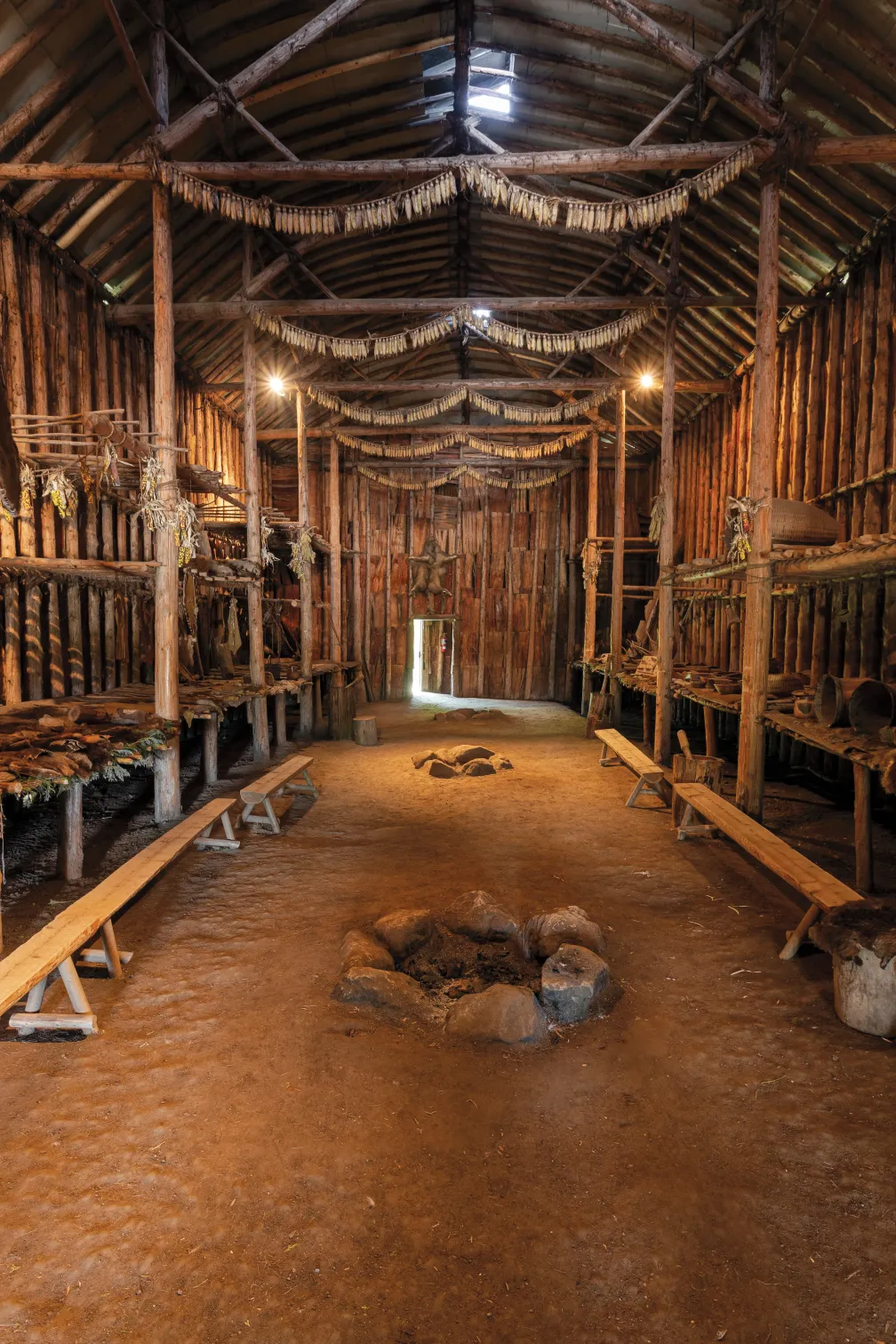
Humans living near Crawford Lake have left their mark in the lake’s sediments since at least the 1200s. Researchers learned this in the 1970s when Maria Boyko, a graduate student of then ROM Curator John “Jock” McAndrews, unexpectedly found evidence of corn pollen in a sediment sample from the lake. Her research led to archaeological excavations and the later reconstruction of longhouses on the site where Indigenous Ancestors had originally built their homes.
“Few realize how lake sediments dating from this time revealed human connections to wildlife. We now know that migrating Canada geese were drawn to the lake when people grew corn and other crops, which is what changed the lake’s chemistry in a way that started the annual varve formation we still see today,” says Brothers. In the last 75 years, the lake has recorded significant local and global markers of human-caused change. In the 1950s, the sediments captured an increase in fly ash (a byproduct of burning coal) that coincided with the rapid industrialization of the nearby city of Hamilton. Around the same time, plutonium released into the air from worldwide nuclear weapons testing was also captured in the core. Just two years ago, in 2023, Crawford Lake received international attention when it was selected as the world’s best marker of a proposed new geological epoch defined by human-caused change: the Anthropocene.
Today, Crawford Lake remains an active site for environmental study. Team Crawford, an international group of researchers, artists, and others lead by Dr. Francine McCarthy at Brock University, is still gathering and presenting the evidence for Crawford Lake as a site of global importance. At the lake, the story of our planet continues to unfold as new sediment layers form each year. What will the next varves tell us?
..
Stephanie Philp is an Interpretive Planner at ROM.
