Now Known as Canada


- Category
- Onsite Lessons with Museum Educators
- Duration
-
30 min gallery + 30 min lab
- Audience
- Educators, French Presentation, Schools
- Age
-
8+
- Grades
- 3-12
- Subjects
- Art & Culture, Canada, Canadian & World Studies, General, History, Indigenous, Language, Social Sciences & Humanities, Social Studies
About this lesson
Engage with the stories that historic objects and belongings reveal about the complex, layered, and contentious history of the lands now known as Canada, and use them to move forward with deeper understanding, empathy, and optimism.
How do the stories, perspectives, and relationships of the past help us to understand the lands now known as Canada today and to shape a better future?

The country now known as Canada has been, and continues to be, shaped by many forces. Treaties and trade, cooperation and conflict, imperialism and colonisation, loss and resilience have all shaped the lands we call home today.
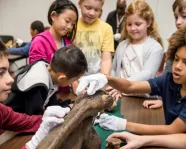
The relationships between different Indigenous Nations and communities, settlers, and Governments are complex and interconnected. In this lesson, Museum Educators create a collaborative learning environment where students share observations, ask questions, and build understanding together as they make meaning from the stories and perspectives reflected in objects and belongings from the galleries and learning labs.
Elementary students will examine significant events, individuals, and perspectives that have shaped Canada’s history and the relationships between Indigenous Peoples and settlers. Through inquiry, discussion, and the examination of historical objects and stories, students will consider multiple perspectives, build historical understanding, and reflect on how the past continues to influence communities and relationships today.
Secondary students will investigate how historical events, decisions, and relationships continue to shape contemporary issues such as sustainability, migration, equity, and community well-being. Through collaborative inquiry and discussion, students will examine historical and current perspectives, make connections between past and present, and explore meaningful ways to engage with these issues in their schools and communities. Together, they will develop ideas and action plans that support informed citizenship and positive change.
| Delivery Language | This lesson is offered in English and French. |
|---|---|
| Lesson Times | 10:30 AM, 12:15 PM |
| Activities |
|
| Galleries/Location | First Peoples Art & Culture, Life in Crisis |
| Format | Gallery & Lab Lesson |
| Duration | 30 min gallery + 30 minute lab |
| Pricing | $18.50/person (Free for First Nations, Inuit, and Métis students) |
| Minimum Group | 15 |
| Maximum Group | 35 |
Learning Goals
Examine the significance of key events, people, and policies in Canada’s colonial history, with particular attention to Indigenous experiences and perspectives
Analyze ways in which historical events are understood differently depending on perspective, and how sources shape our interpretation of the past
Understand how past relationships and actions continue to influence present-day Indigenous-settler relations, social inequalities, and efforts toward reconciliation
Learning at ROM

What makes these lessons unique is that they are taught by trained Museum Educators with diverse areas of specialization, who develop individual lesson plans around set learning goals.
This allows them the flexibility and adaptability to meet student interests and follow where their curiosity leads, respond to class needs and ever-changing conditions in the dynamic environment of a busy Museum, and incorporate the latest studies, pedagogies, and technologies.
We also understand the value of learning from the real thing whenever possible, not relying exclusively on models and copies. Even in gallery lessons, Educators take every opportunity to let your students engage in hands-on learning with something real that has its own history and stories to tell.
These tested approaches to learning mean that you may never get the same lesson twice, but they will always be engaging, interactive, and memorable.
Highlights


Curriculum Connections
Social Studies
- Heritage and Identity: Communities in Canada, 1780– 1850
- People and Environments: Living and Working in Ontario
Social Studies
- Heritage and Identity: Early Societies to 1500 CE
- People and Environments: Political and Physical Regions in Canada
Science
- Life Systems: Habitats and Communities
Social Studies
- Heritage and Identity: Interactions of Indigenous Peoples and Europeans prior to 1713, in What Would Eventually Become Canada
- People and Environments: The Role of Government and Responsible Citizenship
Social Studies
- Heritage and Identity: Communities in Canada, Past and Present
- People and Environments: Canada’s Interactions with the Global Community
History
- New France and British North America, 1713–1800
- Canada, 1800–1850: Conflict and Challenges
History
- Creating Canada, 1850–1890
- Canada, 1890–1914: A Changing Society
Geography
- Exploring Canadian Geography
Canadian and World Studies
- Canadian History since World War I
First Nations, Métis, and Inuit Studies
- Expressions of First Nations, Métis, and Inuit Cultures
Canadian and World Studies
- World History since 1900: Global and Regional Politics in Action: Making Change
First Nations, Métis, and Inuit Studies
- World Views and Aspirations of First Nations, Métis, and Inuit Communities in Canada
Social Sciences and Humanities
- Equity, Diversity, and Social Justice
Canadian and World Studies
- Canada: History, Identity, and Culture
- Canadian and International Politics
First Nations, Métis, and Inuit Studies
- First Nations, Métis, and Inuit Governance in Canada
Social Sciences and Humanities
- Equity and Social Justice: From Theory to Practice
Please note
During the hands-on labs, students have the opportunity to interact with many objects, some of which are heavy. If a student lifts and drops an object, it may result in injury to themselves, to others, or to the collections. Please ensure students are following safety instructions and handling objects responsibly.
Related activities