Down the psychedelic rabbit hole



Publié
Catégorie
*
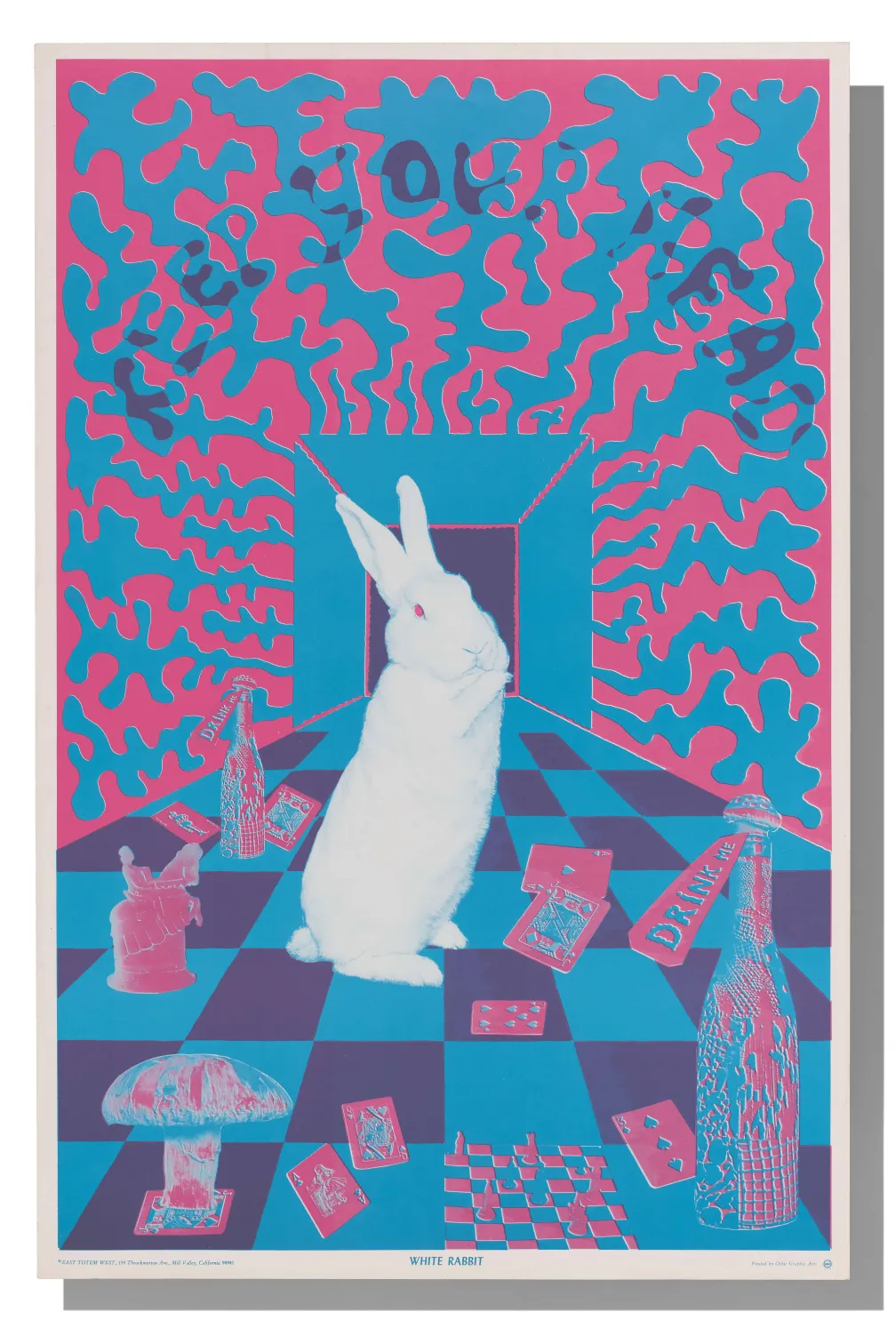
The museum elevator dings and its doors open, revealing a sprawling wall decal of a white rabbit disappearing down a red portal. Through the Psychedelics: Art. Culture. Science. exhibition doors, another white rabbit appears—this time atop a chessboard in a black light rock poster. While the other rabbit fled, this rabbit, as the label text notes, “sits upright expectantly, perhaps inviting you on a journey.”
It’s not the first rabbit to do so. Alice in Wonderland—Lewis Carroll’s 1865 novel, which inspired Jefferson Airplane’s iconic 1967 song “White Rabbit” and the exhibition poster—opens with the chapter “Down the Rabbit-Hole.” In it, little Alice spots a “White Rabbit with pink eyes” who “pop[s] down a large rabbit-hole under the hedge.” Alice follows the rabbit “down, down, down” the hole.
So begins her adventure—and the visitor’s. Much like Alice, visitors are invited to dive down the rabbit hole of psychedelics, a journey spanning cultures, continents, and millennia. It’s also an apt metaphor because the exhibition doesn’t instruct so much as encourage exploration.
“What we’re hoping to do is open people’s minds,” says Dr. Justin Jennings, curator of the exhibition and ROM Senior Curator of Archaeology of the Americas. “We’re not going to give you any answers.”
Among the first stops on the exhibition’s mind-opening journey is the natural world. Behind an expansive glass display case are photographs, pressed plants, specimens, and 3D models of everything from fly agaric mushrooms, the toxic and hallucinogenic fungus Alice eats in Wonderland, to the Sonoran Desert toad, whose toxins once dried form a powerful crystallized psychedelic dubbed the “God Molecule.” As the label text reminds us, psychedelics can come from plants, fungi, and even animals. Plus, many lab-made psychedelics have their roots in nature. (LSD, for example, was derived from the ergot fungus, which grows on rye and can cause hallucinations, high fever, and even death.)
For those travellers curious about the visceral experience of a trip, the exhibition includes an immersive, four-minute “psychedelic journey.” After passing through thick black curtains, visitors emerge into a dim room wallpapered with psychedelic swirls of colour. As 360-degree sound rises in intensity, a large pillar displays whirling fractals, zooming tunnels, and light that makes the walls appear as if they’re breathing. The idea is to evoke the sense of an intense cosmic trip, including the feeling of ego death—the dissolution of self so central to the mystical experience.
Once back through the curtains, visitors move into the art and culture section of the exhibition. Through psychedelic paintings, ceremonial objects, musical instruments, and more, the exhibition shows how cultures around the world and across the ages have used psychedelics to awaken consciousness, commune with ancestors, connect to the divine, resist authority, and heal.


*
One of those cultures is the Indigenous Huichol of western Mexico, for whom peyote is a sacred plant and whose richly detailed yarn paintings reflect the Huichol’s complex cosmology and reverence for peyote. “Every element—the earth, the rain, the seasons of the year—is a creature of the gods,” Huichol Elder Francisco Carrillo Zamora is quoted in the exhibition. “Peyote brings us to them.”
While the Huichol cosmology might seem far removed from our own lives, Jennings urges visitors to pay attention. “As we look to the future, we must learn what we can from the hundreds of past and contemporary cultures that have used psychedelics for millennia,” he writes in Psychedelics: Culture. Crime. Cure., the companion book to the exhibition. “They have much to teach us.”
Many visitors will be surprised that historical Canada—yet another section in the exhibition— also has much to teach us about psychedelics.
“In the 1950s, Canada was home to some of the largest and most significant psychedelic experiments in the world,” says Dr. Erika Dyck, a professor and a Canada Research Chair in the History of Health & Social Justice at the University of Saskatchewan. “During that period, researchers were using psychedelics like LSD and mescaline to try and understand how they affected addictive behaviour, specifically alcoholism, but also how these substances offered a temporary window into psychosis, something that was a persistent problem in large-scale mental hospitals.”
Dyck says that psychedelic researchers like the British-trained psychiatrist Humphry Osmond, who worked at the Weyburn Mental Health hospital in Saskatchewan, also sought out Indigenous knowledge of psychedelics, “which pushed psychiatrists to think outside of the western clinical box.”
The exhibition shows how cultures around the world have used psychedelics to awaken consciousness, connect to the divine, and heal.
d


*
Kelly Daniels is a member of Sturgeon Lake First Nation and past President of the Native American Church of Canada. He notes in the exhibition that Osmond joined a Native American Church peyote ceremony with Daniels’s grandfather in 1956 to “better care for his patients at Weyburn Hospital.”
Just as Osmond relied on the knowledge of the Native American Church, so does the exhibition, which includes a photograph of a teepee and a case of ceremonial objects crafted by Daniels’s son for display in the Museum. “What we are displaying here with the teepee and the ceremonial items is the transmission of generations,” says Daniels. “And it all connects with Humphry Osmond and my grandparents.”
After the promising research in the 1950s and ’60s, psychedelics escaped the lab, fuelling the emerging counterculture movement. That’s the subject of the Psychedelic Era in the exhibition. On a vintage TV and video projection on the wall, visitors are taken from the hippie era including a stop at the 1967 Human Be-In in San Francisco with a cameo from psychedelic iconoclast Timothy Leary—to Richard Nixon’s War on Drugs. Far from a dry history lesson, it’s a prescient reminder that, without proper guardrails, psychedelic drugs can stoke fear and chaos.
From there, the exhibition brings us back to our moment the so-called psychedelic renaissance—with a collage of newspaper headlines dangling from the ceiling like storm clouds.
“The point is psychedelics are here; they’re everywhere,” says Jennings. “There are a lot of people helped by psychedelics, but there are some issues we have to work through. So we’ve got to talk about this, and ROM is a place where we can do that.”
This is why the exhibition ends not with more information but with a challenge. Against a large mural of a setting sun by illustrator and pop-culture cartoonist Brian Blomerth, visitors are asked to consider how their attitude about psychedelics has changed. Written in pencil on speech- bubble-shaped sticky notes, those answers now fill almost an entire wall.
For Jennings and the exhibition development team, they’re a welcoming sight. Because the future of psychedelics in Canada isn’t up to ROM.
It’s up to all of us.
*
Colin J. Fleming, ROM Executive Writer and Creative Communications Strategist, developed the initial concept for Psychedelics: Art. Culture. Science. in collaboration with Dr. Justin Jennings.
