Bio
- Ph.D. Classical Archaeology, King’s College London, University of London
- M.A. Classical Art History, Courtauld Institute of Art, London
- B.A. Literae Humaniores (Classics), University of Oxford
Dr. Kate Cooper is the inaugural Mirkopoulos Associate Curator of Ancient Greece & Rome and is responsible for ROM’s collections from the ancient Greek and Roman world which encompass a large area of the ancient Mediterranean over more than four millennia from the Bronze Age to the fall of the Byzantine empire. She also teaches courses about ancient Mediterranean history and material culture for the University of Toronto and University of Toronto Scarborough.
Dr. Cooper has worked with ROM since 2012 when she was the Rebanks Postdoctoral Fellow for Greece and Rome. In 2015-2016 she was an Assistant Curator for the exhibition Pompeii: In the Shadow of the Volcano and was then a department Research Associate until becoming Associate Curator in 2025. Before coming to ROM, she worked in curatorial positions in England at the Fitzwilliam Museum, Cambridge, where she redisplayed the permanent Greece and Rome gallery, and in the Department of Greece and Rome at the British Museum, London. She has also taught at Birkbeck College, London, the University of Cambridge, and at York University, Toronto.
Her particular speciality is the archaeology, history, and society of the Early Iron Age, Archaic, and Classical Greek world. Her Ph.D. focused on the decorated pottery produced in archaic Corinth and what the archaeological contexts of this pottery revealed about trade and the formation of identities in different areas around the archaic Greek world. Currently, she is running a project, in collaboration with faculty from the Department of Classics at the University of Toronto, to research and publish ROM’s large collection of ancient Greek coins. This has received federal funding from the Social Sciences and Humanities Research Council (SSHRC).
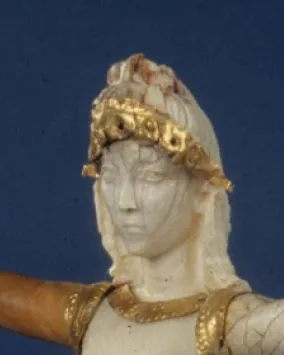
Dr. Cooper also seeks to show the ways in which ancient material culture is still relevant today. She uncovers the hidden histories of ancient artefacts to show how their life stories, collection histories, and current existence as museum treasures have shaped public understanding of the objects, and have affected perceptions of the Classical world more widely. This approach can be seen in her work on ROM’s iconic, but controversial ‘Minoan’ ivory Bull-Leaper figurine. She also explores contemporary uses of, and responses to, the ancient Greek and Roman world.
In all her work across different Greek and Roman periods, she contextualises the ancient art and archaeology by considering the historical and cultural developments of the era in which it was made and used. This interdisciplinary approach is essential for studying ancient material culture, as she highlights in her edited volume New Approaches to Ancient Material Culture in the Greek & Roman World (Brill, 2021).