Evolution: From the Seas to the Skies


- Category
- Onsite Lessons with Museum Educators
- Duration
-
30 min gallery + 30 min lab
- Audience
- Educators, French Presentation, Schools
- Age
-
14+
- Grades
- 9-12
- Subjects
- General, Science, Science & Technology
About this lesson
Examine a variety of evidence, including fossils, specimens, and research, to discover the history and ever-changing nature of life on Earth, and to understand how these changes affect us today.
What can fossils, specimens, and new technologies tell us about how life on Earth has changed and continues to change today?

Evolution is the process of biological change over time, driven by the relationships between species and their environments.
Are dinosaurs really extinct, or are they nesting in the schoolyard today? Why do birds, bees, and bats all soar through the skies? Do snakes and whales have legs? Are humans really descended from monkeys? Are we still evolving? Evolution is a topic that inspires curiosity and big questions, which this lesson approaches through discussions of concepts like convergent evolution, co-evolution, and selective pressures.
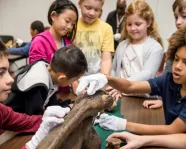
An Evolution lesson at ROM provides an unparalleled opportunity to observe and understand these changes by examining species within their environments in the galleries, and by conducting close-up examinations of objects and specimens in a hands-on learning lab.
Lessons are influenced by grade-appropriate curriculum links. Specific grades may discuss:
- How ancient stromatolites provide clues to how cellular respiration and photosynthesis transformed Earth’s atmosphere
- How dynamic balances in ecosystems can create evolutionary pressures
- How the explosion of biodiversity led to the origins of the cells, tissues, and organ systems we see today
- How multiple examples of flight demonstrates convergent evolution
- How modern medical technologies have provided remarkable insight into ancient life
| Delivery Language | This lesson is offered in English and French |
|---|---|
| Lesson Times | 10:30 AM, 12:15 PM |
| Activities |
|
| Format | Gallery Lesson & Lab |
| Galleries/Location | Dawn of Life, Schad, Dinosaurs, Ice Age Mammals |
| Duration | 30 min gallery + 30 min lab |
| Pricing | $18.50/person (Free for First Nations, Inuit, and Métis students) |
| Minimum Group | 15 |
| Maximum Group | 35 |
Learning Goals
| Grade 9 |
|
| Grade 10 |
|
| Grade 11 |
|
| Grade 12 |
|
Learning at ROM

What makes a lesson at ROM unique is that they are taught by trained Museum Educators with diverse areas of specialization who develop personalized lesson plans around set learning goals.
This allows them the flexibility and adaptability to meet student interests and follow where their curiosity leads, respond to class needs and ever-changing conditions in the dynamic environment of a busy Museum, and incorporate the latest studies, pedagogies, and technologies.
We also understand the value of learning from the real thing whenever possible, not relying exclusively on models and copies. Even in gallery lessons, Educators take every opportunity to let your students engage in hands-on learning with something real that has its own history and stories to tell.
These tested approaches to learning mean that you may never get the same lesson twice, but they will always be engaging, interactive, and memorable.
Highlights


Curriculum Connections
Science - Biology
- Sustainable Ecosystems and Climate Change
Science - Biology
- Tissues, Organs, and Systems of Living Things
Science - Biology
- Evolution
Science
- Medical Technologies
Please Note
During the hands-on labs, students have the opportunity to interact with many objects, some of which are heavy. If a student lifts and subsequently drops an object, it may result in injury to themselves, to others, or to the objects in the collections. Please review the importance of handling objects with care during a museum visit, and monitor your students during hands-on activities.
Related activities