The Meaning of Museums

Publié
Catégorie
1
Underneath the glow of the Signy and Cléophée Eaton Theatre stage lights, as parents and children streamed through the gold-tiled Rotunda on the floor above, Josh Basseches addressed the staff and volunteers of ROM. It was late July, the peak of a busy summer, and Basseches, a short five months away from leaving the museum he has led as Director and CEO for a decade, was fielding questions.
After answering one about the Museum’s approach to artificial intelligence, Basseches was then asked something much more personal: What was the accomplishment he was most proud of during his time at ROM? Few would have batted an eye if he’d said a major ROM-original exhibition like Zuul: Life of an Armoured Dinosaur. No one would have been surprised if his answer had been OpenROM, the sweeping architectural reimagining of the Museum that broke ground on Valentine’s Day 2024. Instead, Josh held up a small blue booklet slimmer than this magazine: ROM’s 10-Year Strategic Direction.
First adopted in 2018, the 37-page document is a road map for ROM’s journey to become a “distinctly 21st-century Museum” dedicated to transforming lives by “helping people understand the past, make sense of the present, and come together to shape a shared future in which people flourish in concert with the natural world.” The document amounts to a total reimagining of what it means to be a great museum in today’s world.
For Basseches, who arrived at ROM in 2016, it was not enough for ROM to be excellent—the Museum needed to be meaningful, “to turn outward as never before,” to engage and inspire the public. “Even if you’re dealing with issues related to dinosaur specimens from the Triassic Period, or a statue from ancient Greece sculpted more than 2,000 years ago, the question must be, ‘how does this matter to people’s lives today?’” he says.
This insistence on relevance forms the heart of the Strategic Direction, undergirding much of the work that has gone on at ROM since. This ranges from the Free Main Floor pilot program, which welcomes tens of thousands of visitors into the Museum who otherwise might not be able to visit, to cutting-edge projects like the upcoming Psychedelics exhibition. That’s the reason the Strategic Direction was top of mind for Basseches when he looked back on his tenure.
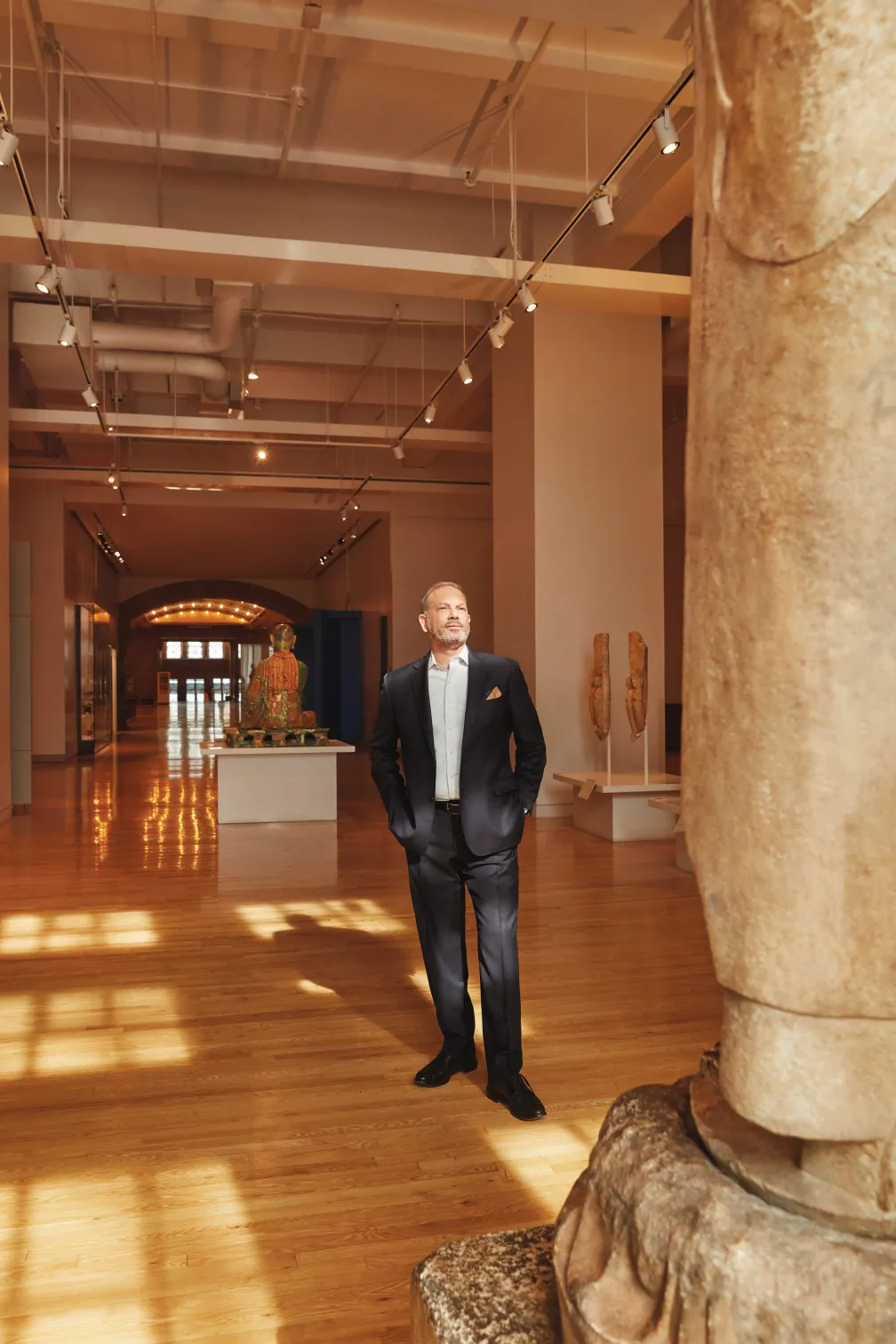
Of course, he’s proud of many other accomplishments too. And on a chilly afternoon in November, just a month before leaving the Museum, Josh Basseches sat down to talk about his 10 years at ROM and what he hopes will be his legacy.
Museums have the power to transform lives. Sometimes, it’s in small ways. Sometimes, it changes the entire course of someone’s life.
2
One of the major themes of your tenure has been inclusion. Why is that so important to you?
As a newcomer to Canada, I was immediately impressed by the diversity of Toronto—the most diverse major city in the world, where more than 50 percent of the people who live here were born outside the country, including, of course, me. The Museum needs to be a place where all people—regardless of background, birthplace, socio-economic status—feel that ROM is their place, that they are welcome here. And to do that, you need to ensure that the Museum is a space where people can see themselves reflected.
So throughout our work, from the upcoming Global Sikh Art & Culture Gallery to the Being and Belonging exhibition, our team has been committed to saying, “How do we ensure we are a museum where communities feel at home?” And, of course, Indigenous communities are a crucial part of that intention. That is why we have been working with Indigenous staff and community members on updating the Daphne Cockwell Gallery dedicated to First Peoples art & culture, in addition to hosting exhibitions like TUSARNITUT! Music Born of the Cold.
Over the 2017–18 fiscal year, ROM welcomed 1.44 million visitors—the highest attendance numbers achieved in the Museum’s 104-year history. What made that historic moment possible?
What drives major attendance in museums is exceptional, meaningful exhibitions and programs, built on innovative research and supported by compelling marketing and communications. In other words, “What it is that we’re offering, and how we tell people about it in a way that motivates them to come to the Museum?”
Two thousand seventeen was an amazing year, anchored by Out of the Depths: The Blue Whale Story, a phenomenal exhibition that highlighted a full-sized skeleton of a blue whale that ROM scientists had recovered. We also had the exhibitions VIKINGS, Anishinaabeg: Art & Power, and Christian Dior, which captivated our audiences. These projects were supported by a significant investment in marketing that provided a megaphone to reach people.
That year was also the 150th anniversary of Canada’s Confederation, and a lot of people were visiting Canada. All those factors came together in a perfect attendance storm.
Over the last decade, ROM has hosted an array of remarkable exhibitions, many of which were developed right here. What two exhibitions are you most proud of and why?
Hmm. It’s a little hard to pick your favourite child, so I’m just going to focus on recent exhibitions. Auschwitz. Not long ago. Not far away., which closed in September, is one of the most important exhibitions this Museum has ever hosted. The exhibition spoke not just to the horrors of the Holocaust but to the systems, people, and beliefs that allowed it to happen. And, of course, it included the five Connection Stations we created, which asked people to examine their own unconscious biases in the context of Museum objects.
I am also very proud of Kent Monkman: Being Legendary. Kent’s art is incredibly powerful, and the narrative in that exhibition—the continuity of Indigenous history and knowledge over immense time—was so important. Being Legendary is also an example of how we can better engage with Indigenous communities, because in the case of this exhibition, we truly turned the gallery over to Kent and his team to imagine and develop, with ROM staff in a supporting role. That’s not something museums in general find easy to do and specifically not something this Museum would have done 10 or 20 years ago.
Finally, I am proud of exhibitions like The Cloth that Changed the World: India’s Painted and Printed Cottons and the award-winning Bloodsuckers: Legends to Leeches, which highlight the rich collections and cutting-edge research of this institution—and which are now travelling the world.
OpenROM broke ground in 2024. How do you see it changing the Museum?
I always think about major capital projects in terms of how they fulfill the strategy of the institution, that they’re not just building for building’s sake. Our goal is to make ROM even more of a community and cultural hub, and OpenROM is the physical manifestation of that intent. It’s about how we can throw our doors open even wider, make the Museum even more welcoming, and ensure that people of all backgrounds can come and go more easily.
And when we reopen the newly renovated main floor, it will be free and open to all and have compelling programming as close to 24/7 as we can reasonably get, which was made possible by the Temerty Foundation. All of these efforts are in the service of making the Museum a dynamic, inviting place where people want to hang out, whether for a half hour or for the whole day.
By the end of the year, you will have spent a decade as ROM Director and CEO. What would you like your legacy to be?
As I make my way around the galleries, or out and about in Toronto, people often come up to me and say things like “I just brought my son to the Museum, and he fell in love with dinosaurs.” Or “I came for a program on Canadian art, and the speaker was so amazing that she really changed the way I think.” Museums have the power to transform lives. Sometimes, it’s in small ways. Sometimes, it changes the entire course of someone’s life. And if over my decade of leadership at ROM, we have helped create those kinds of transformational experiences, that’s the legacy I’d like to leave.
This conversation has been edited for length and clarity.
3
Colin J. Fleming is Executive Writer & Creative Communications Strategist at ROM.
