Sensory Explorations



- Published
- Category
-
Exhibitions & Galleries
d
Shokkan, or the sense of touch, is a critical component in the creation, appreciation, and circulation of Japanese art. Yet the importance of shokkan is often taken for granted. It has never been explicitly analyzed as something that penetrates many aspects of Japanese art beyond discussions like “Japan is a country of handmade objects,” or “the true beauty of tea utensils cannot be understood without holding them in your hands.” ROM’s newest exhibition examines Japanese art through the concept of shokkan.
There is a complexity to the term shokkan. In Japanese, two terms can be translated as “the sense of touch”: shokkaku and shokkan. The former refers to the haptic physical sensation directly felt by the part of the body touching something. Shokkan, on the other hand, refers to the psychological impression of touch, which is composed of various inputs from other senses, like vision or hearing, as well as from memories or words.
This multi-faceted sensory understanding of touch is deeply rooted in Japanese art, where tactility plays an integral role in the creation and appreciation of the object’s texture. The exhibition Shokkan: Material Encounters in Japanese Art examines this complexity through a broader perspective—emphasizing the importance of the handmade and the textural, of surface decoration and imagined touch, rather than relying on a simple dichotomy of the touchable versus the untouchable. Taking Japanese art as a case study, this exhibition looks to promote a new awareness of touch, diversifying how we appreciate art of all kinds.
Handmade objects have always been valued and appreciated in Japan, as in many other cultures, especially after the rise of industrialization and mass production in the 20th century. In Japan, a maker’s hands are not simply considered tools; rather, hands mediate the relation between an object and a maker’s mind or spirit. Muneyoshi Yanagi, the founder of the Japanese Mingei folk-art movement, for instance, states that “hands are different from machines in that they are directly connected to the spirit (kokoro)” and calls Japan “a country of handwork.”



d
Making objects by hand takes more time and effort than mass production. Yet some potters still insist on producing hand-formed items, such as Raku-type pottery, without using a potter’s wheel. Furthermore, Raku ware’s firing method, which uses small indoor kilns, is unsuited to large-scale production. Morgan Pitelka, in the book Handmade Culture, explains the relationship between the inefficiency of making Raku tea bowls and their tactility: because the low-temperature firing results in low thermal conductivity, Raku tea bowls are pleasant to hold even when filled with hot tea; and the process of shaping a bowl involves more handling by the potter, which results in the potter paying more attention to how the bowl feels to the user. Handmade objects are not simply “made by hands” but embody multi-layered tactility, including the direct handling by the maker, the maker’s imagination of the user’s hands, and the eventual user’s actual touch.
Out of the five senses, only touch and taste involve direct contact with an object. Touch is always double-sided: when you touch something, you are simultaneously being touched by it. This directness and double-sidedness make touch unique, personal, and thus, multivarious. The double-sidedness of touch can be found in many Japanese works of art that also serve as utilitarian objects.
Japanese swords, for example, are appreciated as works of art today, but they were a true weapon before the mid-19th century. The handle of a sword was made to secure a good grip: the wooden core was first covered by textured rayskin, then wrapped with silk cords with a pair of small metal menuki inserted underneath. Originally simply functional, the sword fittings developed into intricate ornamentation too that demonstrate the bearer’s status and aesthetic.
In Western culture, oil paintings are created solely for the purpose of visual appreciation and are thus framed and hung on the wall; once mounted, they are rarely moved or replaced. Moreover, their materials are not light sensitive, which means they are hardly handled at all. By contrast, traditional Japanese paintings are constantly handled. Take screen paintings, for example. While they are created to be viewed, they also function as protection from drafts or as room partitions in sparsely furnished Japanese houses. Portable and free-standing, they are frequently changed according to the season and occasion. The light-sensitive materials used in Japanese painting also require frequent replacement and careful storage. As in the case of the makers of Raku tea bowls, the mount makers of Japanese paintings are always aware of these factors and hence pay careful attention to the tactile quality of an object’s surface.
Other types of Japanese paintings also require frequent handling. Hanging scrolls are displayed during certain periods of season or occasion, and once the period ends, they are replaced and stored away. Viewing a hand scroll is an embodied experience: the viewer repeatedly rolls and unrolls the scroll with both hands, revealing a scene as wide as their shoulders.
Experiencing the texture of objects via touching them is an essential part of appreciating Japanese art. The patina of a netsuke from long-time use, for example, is a crucial factor in appreciating it: netsuke’s beauty partially comes from the human sebum built up through frequent touch. The aesthetic value of a tea bowl too is determined by how it fits in one’s palm: its shape, weight, and the texture of its glaze.
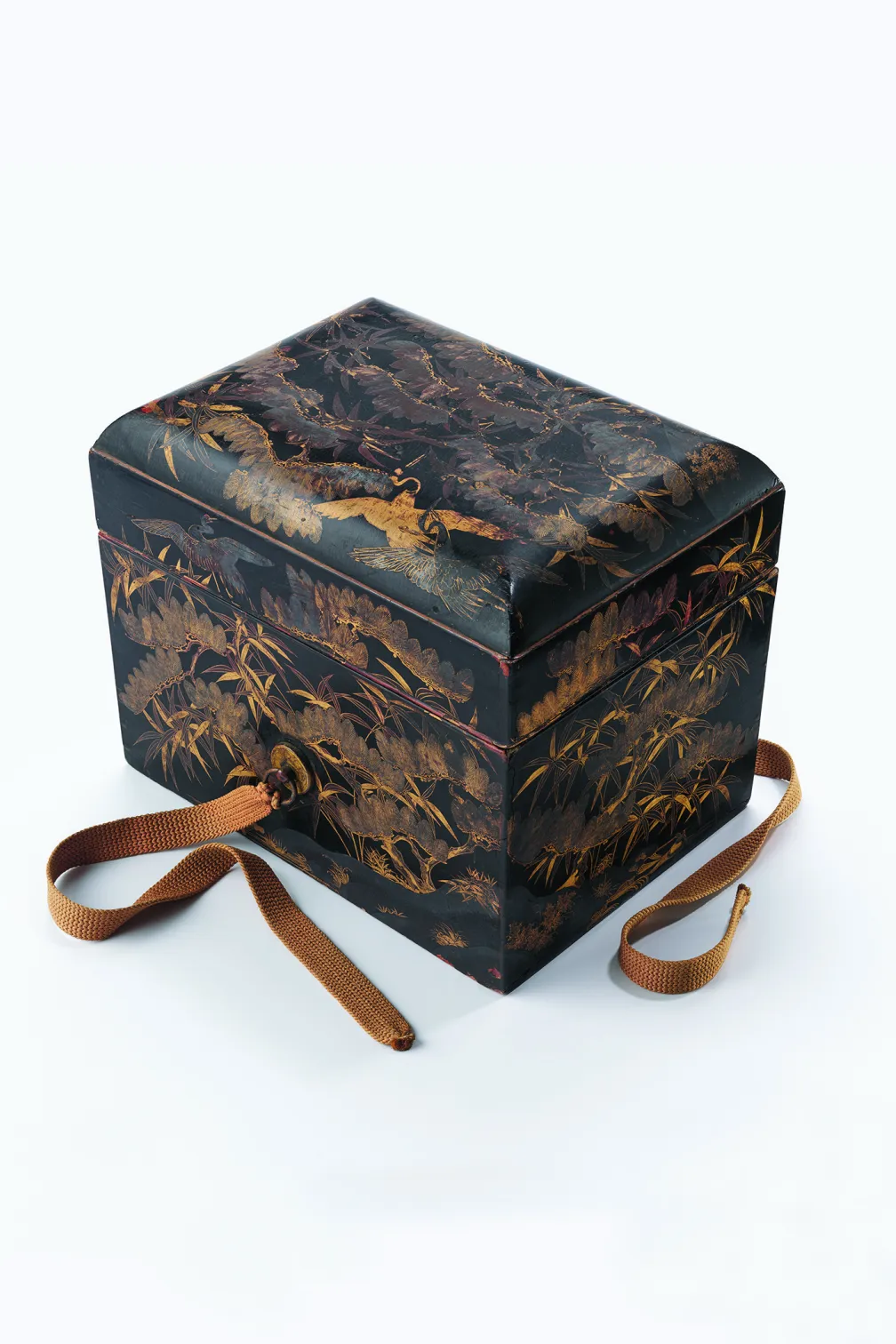
The importance of texture has led the techniques used to decorate the surfaces of objects to become highly developed. One of the best examples of this is maki-e lacquer decoration, in which a design is made by sprinkling or spraying wet lacquer with metallic powder, such as gold or silver. This complex decoration technique was developed during the Heian period (794–1185) and has become a representative Japanese lacquering method. The textured surface of a kimono, featuring embroidery and shibori tie-dyeing, provides another example. The process of shibori dyeing includes multiple labour-intensive techniques to create raised, dotted patterns.
A more recent example of a distinct texture of textile might be found in the world-renowned permanently pleated garments innovated by Issey Miyake. Intended as simple, everyday wear, the pleated garments accommodate any body types and movements, providing the wearer with a sense of individuality and freedom in daily life. The unique feeling of pleats on skin may represent the ultimate form of shokkan.
The sense of touch also seems to have played an important role in the global circulation of Japanese objects from the mid-19th to the early 20th centuries. This was a period when an obsession with Japanese art and aesthetics, known as Japonisme, swept through Western Europe and North America. During this time, small objects that could be held in one’s hands, such as netsuke, incense boxes, and tea bowls, were avidly collected. Since they were small and relatively inexpensive, they often became the subject of a collector’s profound interest, leading to the amassing of large collections of similar small objects. In addition to small objects, shunga, or Edo-period erotic prints depicting explicit sexual activities, were also one of the most popular items for Western collectors, likely because of their nature of evoking the sense of touch.
It is notable that the objects collected during the craze for things Japanese in the mid-19th and early 20th centuries have since formed the essential parts of Japanese collections in many Western museums, including ROM. Reinterpreting Japanese objects held by the Museum via touch is thus also an attempt to explore the multiple layers making up Western perspectives toward collected Japanese objects.
Touch is ubiquitous; every culture experiences tactile beauty. Thinking about touch is also highly relevant to today’s social conditions. The global experience of the COVID-19 pandemic has made us suddenly conscious of the warmth of another’s body, of touching the surfaces around us—acts that had been taken for granted. Unlike other senses, our sense of touch cannot be suspended. It is meaningful today to foreground this easy-to-forget sense of tactility as an alternative way to engage with art. Tactile beauty is all around us, just waiting to be discovered.
Excerpt from the publication Sense of Touch: Shokkan and Sensory Exploration in Japanese Art. This article has been edited for length and clarity.
c
Akiko Takesue is the Bishop White Committee Curator of Japanese Art & Culture at ROM
