From Seabed to Summit


- Published
- Category
-
Science
- Author
-
1
A remarkable story is underfoot in the Canadian Rockies. Below the treeline conifers carpet the slopes above glaciers and deep blue lakes. Today, visitors may see marmots, bighorn sheep, and bears. Generations of the Ktunaxa and Secwépemc peoples have sustained themselves on this land, which has traditionally provided them with clothing, shelter, and medicine. But around 505 million years ago, during the Cambrian Period, the rocks that make up these mountains were an ocean seabed teeming with life. A variety of organisms lived in this marine community swimming in the water, walking or crawling on the bottom, or digging or anchoring themselves in the sediment.
From time to time, mudslides of fine silt rushed down, smothering the animals but also protecting their remains from scavengers and reducing microbial decay. Layers of silt accumulated over time and became compressed into shale, flattening the remains and encouraging their mineralization and eventual fossilization. The fineness of the silt and the speed of burial preserved not just the hard parts of animals, such as shells, but also their fleshy parts.
We now know this area as the Burgess Shale in British Columbia, a UNESCO World Heritage Site since 1980. The Burgess Shale is home to fossils in which the soft tissues of many organisms have been preserved in exquisite detail. Thanks to this exceptional preservation, the Burgess Shale fossils provide us with a rare peek at some of the first animals that evolved on Earth. While many Burgess Shale fossils may look alien to us, most can be shown to belong to major animal groups still alive today, including those of our own lineage, the vertebrates.
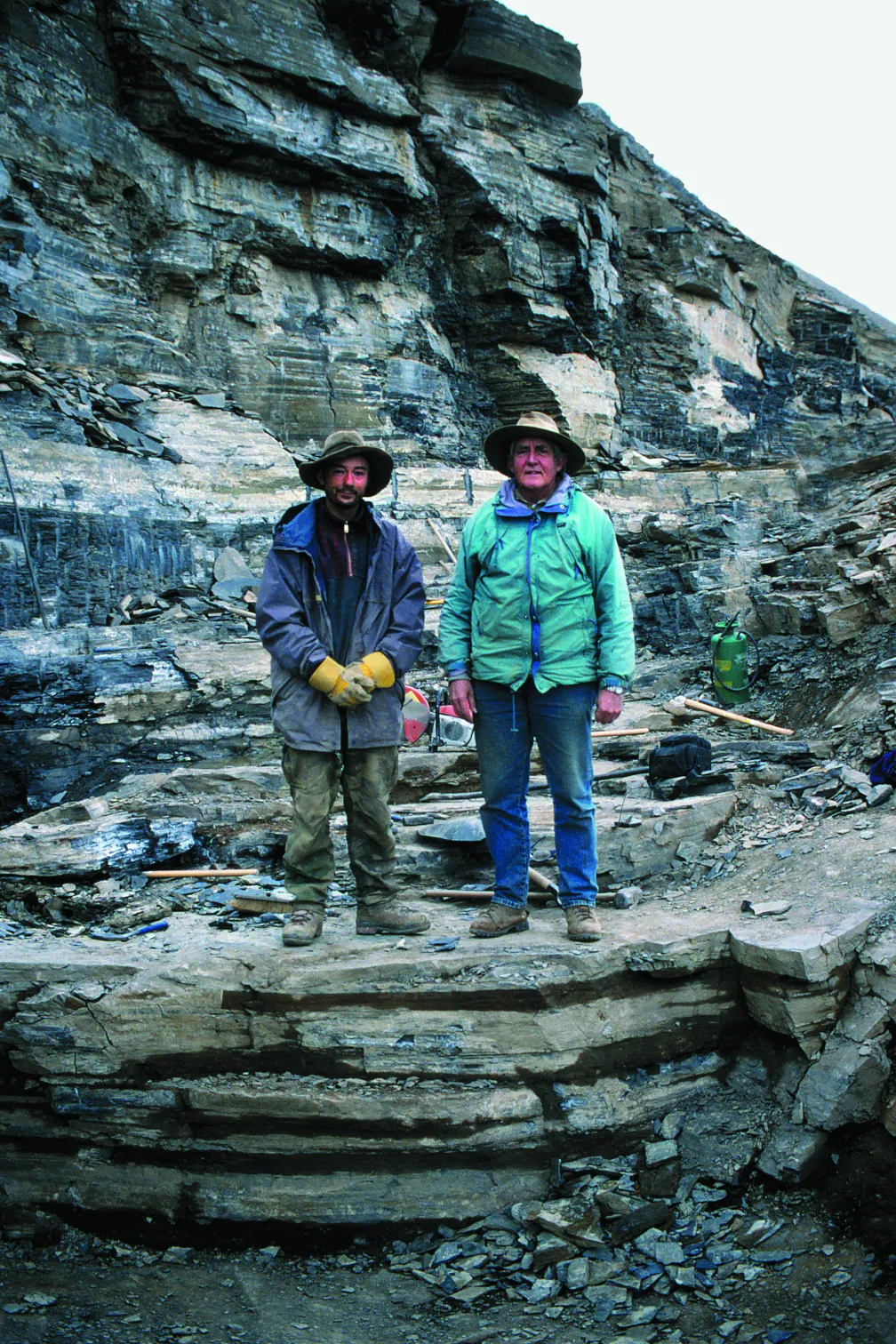
ROM scientists Dr. Desmond “Des” Collins (1938–2023), Curator of Invertebrate Palaeontology from 1968 to 2004, and Dr. Jean-Bernard Caron, who joined ROM in 2006 and is now the Richard M. Ivey Curator of Invertebrate Palaeontology, have been instrumental in improving our knowledge of early animal evolution. Together, they have assembled the world’s largest and most diverse collection of this type of material through dozens of field expeditions since 1975, making the collections at ROM a treasure trove for scientific discoveries.


1
Research into Burgess Shale fossils began in the late 19th century, after the Canadian Pacific Railway was built through the Rockies. A number of geologists noticed fossils of trilobites—an extinct group of arthropods in the area, which drew the attention of American palaeontologist Charles Walcott from the Smithsonian Institution. While exploring, he stumbled across fossils of animals that had never been seen before at a site between Mount Field and Mount Wapta near Field, BC, that he called the Burgess Shale. Walcott amassed large collections of this material for the Smithsonian Institution over several years of quarrying long before ROM got involved.
Des Collins first visited the Walcott quarry in 1972 during a conference and found exhibit quality fossils in the rock debris left by previous collectors. At that time, the only specimens from the Burgess Shale at ROM were a few pieces that Walcott had provided half a century earlier. Collins applied for a research and collection permit from Parks Canada—a federal requirement for collecting from a national park—to obtain specimens for a future gallery at ROM.
The Parks Canada permit required Collins to collect fossils not just for ROM but also for Parks Canada itself, as well as for dozens of other Canadian museums and universities. Collins exceeded Parks Canada’s expectations. With new permits, he spent the next decade locating new field sites and collecting specimens, identifying them if possible, and storing them upon his return from the field in the collections at ROM.
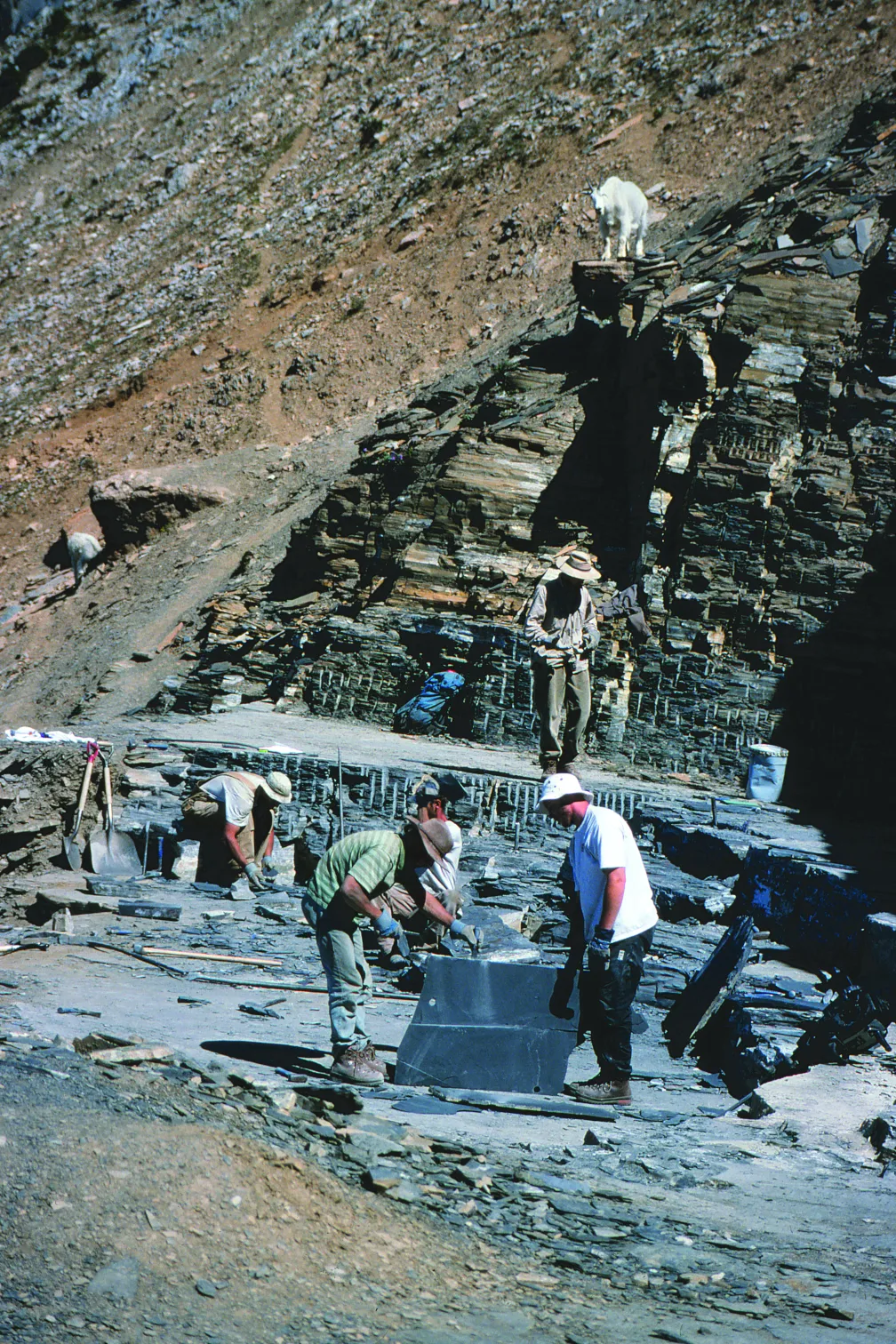
Some specimens were quarried, revealing which organisms were found together as well as the differences between those in younger and older layers of rock, while others came from loose bits of shale that were lying on the ground and had broken off and fallen down from rocks at higher elevations. Further expeditions would be needed to see exactly which rocks these fossils came from.
The work that Collins did during this period showed that high quality Cambrian fossils were widespread in both space and time within the Burgess Shale formation with many new sites discovered across Yoho National Park.
The peculiar soft-bodied fossil animals described from the Burgess Shale inspired American palaeontologist Stephen Jay Gould to write Wonderful Life (1989), a popular book that brought the site into the public consciousness. Gould argued that many Burgess Shale animals with minimal resemblance to animals living today were oddballs of evolution, distinct lineages with no modern descendants. But research since then, especially using fossils in the collections, has shown that this perspective is not correct. The view today is that focusing on the features these specimens share with modern animal groups rather than on their most bizarre aspects can enable scientists to link these specimens to animals living today.
The changing interpretations of Burgess Shale fossils demonstrate why the continued collection of fossils is key to palaeontological progress. Interpreting fossils is tricky. Many fossil specimens consist of just bits of animals, sometimes body parts that dissociated from the rest of the animal in death. Even when fossilized animal remains are intact, some are preserved in orientations that do not show important features. And some species are known from only one or a handful of specimens. These factors mean that a certain amount of speculation always goes into thinking about how these animals would have appeared when they were alive. Interpretations can be only as good as the data that the palaeontologists have at the time.
Though some of the Burgess Shale animals still have no known modern relatives, the number of such groups is decreasing as ROM teams find more specimens and use new analytical techniques. For example, in the 1980s, Collins introduced polarized lighting to increase the visual contrast when viewing fossils, enabling internal organs and tissues to be differentiated. This simple technique revolutionized the study of Burgess Shale fossils, providing new information about the animals’ anatomy and how they lived.
Over Collins’s long career as a curator, he had three students, one of whom was Jean Bernard Caron. Caron began fieldwork at the Burgess Shale as a volunteer in 1998, when he was still an undergraduate in France. Caron studied Burgess Shale animals for his MSc and joined the ROM as a technician while working on his PhD at the University of Toronto, during which he studied over 70,000 specimens at the Museum. He was hired as a curator in 2006 specifically to work on the Burgess Shale collection.
Caron’s research program began with two priorities. The first was to use the collections at ROM to learn more about the evolution of early animals, especially the enigmatic ones. The second was to determine the extent of Burgess Shale deposits in the Canadian Rockies and to grow the collection at ROM. Since then, Caron’s mandate has grown to include the development of new research techniques and to increase student participation in research projects and public outreach.
From time to time, mudslides of fine silt rushed down, smothering the animals but also protecting their remains and reducing microbial decay. The fineness of the silt and the speed of burial preserved not just the hard parts of their bodies but also their fleshy parts. Thanks to this exceptional preservation, the Burgess Shale provides us with a rare peek into some of the first animals on Earth.
2
An example of a formerly enigmatic species that Caron and his collaborators made less mysterious is Odontogriphus, a creature resembling a puffy skateboard without wheels, or, as Caron puts it, “a flattened Michelin man.” Odontogriphus was described in the 1970s from a single specimen that Walcott had collected but not studied and was considered to be a distant relative of lophophorates, filter feeders alive today. After studying nearly 200 specimens from the collections, Caron and his colleagues published a new interpretation in Nature in 2006 showing that, based on its distinctive mouth parts, Odontogriphus is actually a mollusk.
As new research methodologies are developed and as new discoveries of similarly aged fossils elsewhere in the world provide a broader context, fossil collections at ROM become even more important for future research. As Caron says, these fossils “don’t go bad. There’s no expiration date.”
Since the 2000s, Caron and his team have found many new fossil sites. His students have published on dozens of new species and presented their findings to the public. Many of these species are featured in the Willner Madge Gallery, Dawn of Life at ROM. Notably, in 2012, Caron’s team discovered the Marble Canyon site in Kootenay National Park. Then, in 2023, Caron also found a new and exceptionally rich site in Yoho which remains to be described and made public but promises to provide a wealth of new species to science.
Over the past 50 years, ROM scientists’ research on the animals fossilized in the Burgess Shale has yielded groundbreaking insights into the early evolution of animal life. Caron’s team is regularly interviewed by international TV crews and other news media, spotlighting ROM’s reputation as a top-tier research institute on Cambrian fossils. The collections continue to be available to scientists for deeper study, enabling new discoveries and insights to be made into the enigmatic creatures that lived around 500 million years ago.


1
Visit the Willner Madge Gallery, Dawn of Life at ROM to learn more about the Burgess Shale or go online at burgess-shale.rom.on.ca. For research updates, see Dr. Caron’s webpage.
Sara Scharf has a PhD in the history and philosophy of science and technology. She is currently working as a freelance academic editor.
